
How Often Should I Revise a Topic So I Don't Forget It?
How Often Should I Revise a Topic So I Don't Forget It?
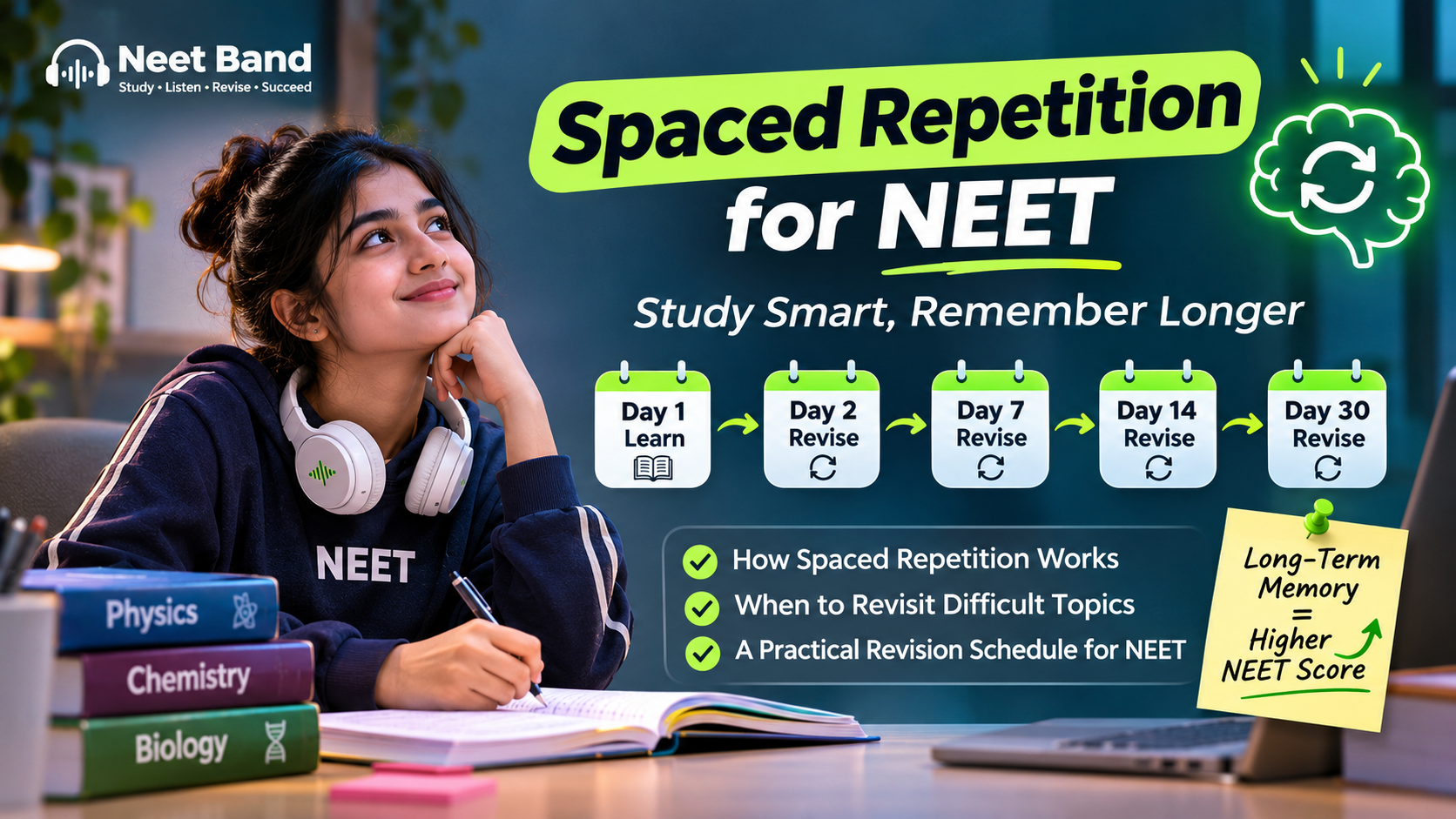
To remember a topic for longer, students should revise it at regular intervals instead of studying it repeatedly in one sitting. This technique is called spaced repetition. A practical starting schedule is to revise a topic on the same day, the next day, after three days, after seven days and then after two weeks. Adjust these intervals according to how well you remember the topic.
Many students study a chapter, understand it and move on to the next one. But when they return to the same chapter after a few weeks, they realise that they have forgotten important details. This is a common challenge, especially for students preparing for competitive examinations such as NEET and JEE.
The solution is not necessarily to study for more hours. It is to revise at the right time, test your memory and revisit difficult topics regularly.
What Is Spaced Repetition?
Spaced repetition is a learning technique in which you revise information multiple times, with gaps between each revision session.
Instead of studying one chapter five times in a single day, you distribute those revision sessions across several days or weeks.
For example, after completing a Biology chapter today, you can revise it tomorrow, revisit it after three days and test yourself again after one week.
The main idea is simple: do not wait until you have completely forgotten a topic before revising it. Return to the information regularly and check how much you can remember.
Why Do Students Forget What They Study?
Forgetting is a normal part of learning. Students receive a large amount of information every day, and not everything can remain equally accessible in memory.
There are several reasons why students may struggle to remember previously studied topics.
1. Studying Once Is Not Always Enough
Understanding a chapter during the first study session does not guarantee that you will remember every detail later. Some information needs to be revisited and practised.
2. Too Much Information Is Studied Together
Trying to complete several chapters in one long session can make revision difficult to manage. Students may remember some information immediately but struggle to retrieve it after a gap.
3. Students Read but Do Not Test Themselves
Reading the same notes repeatedly can make information feel familiar. However, familiarity does not always mean that you can recall the information independently.
Students should regularly close their books and attempt to explain what they have learned.
4. Difficult Topics Are Not Revisited
Students sometimes spend more time revising chapters they already understand because they feel comfortable with them. Meanwhile, difficult topics receive less attention.
A good revision routine should give additional practice to topics that are difficult to remember.
How Does Spaced Repetition Help Memory?
Spaced repetition gives students multiple opportunities to retrieve previously learned information. Each revision session helps them check what they remember and identify what needs more attention.
Research supports the benefits of distributed practice. A major 2006 meta-analysis by Cepeda and colleagues examined 317 experiments and found that the spacing between learning sessions influences later retention. It also highlighted that the most useful revision interval depends partly on how long the information needs to be remembered.
This means there is no single perfect revision timetable for every student. The schedule should consider the difficulty of the topic and the time remaining before the examination.
Research reference: Distributed Practice in Verbal Recall Tasks: A Review and Quantitative Synthesis.
How Often Should You Revise a Topic?
There is no universal revision interval that works equally well for every student. However, beginners can use a simple schedule as a starting point and adjust it based on their recall.
Here is an example of a spaced revision schedule:
Revision SessionWhen to ReviseWhat to DoFirst StudyDay 1Understand the topic and make short notes.Revision 1Day 2Recall the main concepts and check important details.Revision 2Day 4Attempt questions without looking at your notes.Revision 3Day 8Review difficult points and practise MCQs.Revision 4Day 15Test your overall understanding of the topic.Revision 5Day 30Revisit the topic and identify anything you have forgotten.
Important: This is an illustrative schedule, not a scientifically fixed formula. If you cannot remember a topic during a revision session, revisit it sooner. If you recall it confidently and answer questions accurately, you may gradually increase the gap.
How to Use Spaced Repetition Effectively
Following a timetable is useful, but the way you revise matters just as much. Simply reading the same chapter again and again may not be enough.
Follow these steps to make your revision sessions more effective.
1. Divide Large Chapters into Smaller Topics
Do not treat an entire subject as one revision unit. Break it into smaller topics that you can study and test independently.
For example, instead of revising an entire Biology chapter in one session, divide it into definitions, processes, diagrams and important examples.
2. Use Active Recall During Every Revision
Active recall means trying to remember information without looking at your textbook or notes.
After completing a topic:
Close your textbook.
Write down the important points you remember.
Explain the concept in your own words.
Answer questions without checking the answers first.
Compare your responses with the original material.
This helps you identify what you genuinely remember and what needs further revision.
3. Give More Time to Difficult Topics
Not every chapter requires the same amount of revision. Some topics may become easy after two sessions, while others may require several attempts.
Maintain a list of topics that you find difficult. Revisit them more frequently until you can recall the important information confidently.
4. Practise Questions After Revising
Revision should not end with reading notes. Solve questions related to the topic to check whether you can apply what you have learned.
For NEET aspirants, practising relevant MCQs is particularly useful because it helps identify gaps in conceptual understanding and factual recall.
5. Track Your Revision Progress
Maintain a simple revision tracker. Record when you studied a topic, when you revised it and how well you performed.
You can use three simple categories:
Strong: You can remember and explain most of the topic correctly.
Needs Revision: You remember the basics but miss some important details.
Weak: You struggle to recall the topic or answer questions correctly.
Use these categories to decide which topics need attention in your next revision session.
How Can NEET Aspirants Use Spaced Repetition?
NEET preparation involves a large syllabus across Physics, Chemistry and Biology. Students need to balance learning new chapters with revising previously studied topics.
Spaced repetition can help organise this process by ensuring that older topics do not disappear from the study routine while students move forward with new chapters.
1. Biology: Revise NCERT Regularly
Biology includes terminology, examples, diagrams, classifications and biological processes. After studying a topic, close NCERT and try to recall its important points.
During later revision sessions, check the original NCERT content and identify details you missed.
2. Chemistry: Revisit Concepts and Reactions
Chemistry requires students to remember important concepts, reactions, properties and formulas. Divide chapters into smaller sections and schedule separate revision sessions.
Use short recall tests and practise relevant questions to check your understanding.
3. Physics: Combine Revision with Problem-Solving
Physics requires conceptual understanding and the ability to apply formulas correctly. During revision, recall the concepts and formulas, then solve questions related to them.
Do not depend only on reading formula sheets. Check whether you know when and how to use each formula.
Example of a Weekly Revision Routine for NEET Students
Students can combine new learning with revision of older topics. Here is a simple example of how a weekly routine may look.
DayStudy ActivityRevision ActivityMondayStudy a new Biology topic.Revise an older Biology chapter.TuesdayStudy a new Physics concept.Recall Monday's Biology topic.WednesdayStudy a new Chemistry topic.Practise questions from Physics.ThursdayContinue Biology preparation.Revise Tuesday's Physics concept.FridayStudy another Chemistry topic.Recall Wednesday's Chemistry topic.SaturdayComplete pending syllabus work.Revise difficult topics from the week.SundayAttempt a practice test.Analyse mistakes and plan the next week.
This is only an example. Students should adjust the routine according to their syllabus progress, school or coaching schedule and upcoming tests.
What Should You Do When You Forget a Topic During Revision?
Forgetting information during a revision session does not mean that your previous study time was wasted. It tells you that the topic needs more attention.
Follow these steps:
Do not immediately read the entire chapter again. First identify the exact concept or detail you cannot remember.
Try to recall it once more. Give yourself time to think before checking the answer.
Check your textbook. Read the relevant section carefully and correct your understanding.
Practise a related question. Check whether you can now use the information correctly.
Schedule another revision. Revisit the difficult section sooner than your next planned revision.
The goal is to make your revision schedule responsive to your actual learning progress.
Can Audio Learning Support Spaced Repetition?
Audio learning can provide another way to revisit information during revision. Students can listen to educational explanations or study songs to refresh their familiarity with previously studied topics.
For example, a student can listen to an educational song related to a Biology topic and then pause the audio to recall the important points independently.
NEET BAND offers a music-based approach to educational content, giving students another format to engage with study material. It can be explored as a supporting resource alongside textbooks, active recall and question practice.
However, listening alone should not replace independent revision. Students should still check their understanding through recall and practice questions.
Explore NEET BAND or visit the Courses page to learn more.
Common Spaced Repetition Mistakes Students Should Avoid
Following fixed intervals blindly: Adjust your revision schedule according to how well you remember each topic.
Revising only easy chapters: Give additional attention to topics that you regularly forget.
Reading without testing yourself: Include active recall and practice questions in your revision sessions.
Ignoring older topics: Keep previously studied chapters in your weekly revision plan.
Trying to revise everything every day: Organise topics into manageable sessions based on priority.
Not analysing mistakes: Understand why you forgot an answer and revise the underlying concept.
Depending only on a timetable: Your actual recall and understanding should determine when a topic needs another revision.
Frequently Asked Questions About Spaced Repetition
1. How often should I revise a topic to remember it?
You can begin with a schedule such as the same day, the next day, after three days, after one week and after two weeks. Adjust the intervals according to your recall and the difficulty of the topic.
2. What is the 1-3-7 revision rule?
The 1-3-7 rule is a practical revision approach in which students revisit a topic after one day, three days and seven days. It is a planning method rather than a universal scientific formula. Students can adjust it according to their learning progress.
3. Is spaced repetition useful for NEET preparation?
Yes. NEET aspirants can use spaced repetition to revisit Biology facts, Chemistry concepts and Physics formulas. Combining it with active recall and MCQ practice can make revision more structured.
4. Is it better to revise daily or weekly?
Both can be useful. Daily revision can help students revisit recently learned topics, while weekly revision provides an opportunity to review older material. A balanced routine should include both.
5. What should I do if I forget everything during revision?
Identify the sections you cannot remember, review them using your textbook and test yourself again. Schedule another revision sooner rather than waiting for the next long revision interval.
6. Can I use flashcards for spaced repetition?
Yes. Flashcards can help you practise remembering definitions, formulas, terminology and short facts. Review difficult cards more frequently and increase the gap when you can recall the answers confidently.
7. Does spaced repetition mean I do not need to read my textbook again?
No. Textbook reading remains important for understanding concepts and checking details. Spaced repetition helps organise when you revisit information, while active recall and question practice help you test what you have learned.
Final Takeaway: Revise at the Right Time, Not Just More Often
Forgetting a topic after studying it is a common experience. The important thing is to build a revision routine that brings previously learned information back into your study schedule.
Spaced repetition helps students distribute revision across different days and weeks. When combined with active recall, textbook review and regular question practice, it provides a practical approach to remembering information for longer.
If you are preparing for NEET or JEE, do not focus only on completing new chapters. Make time to revisit older topics, check your understanding and work on the areas you find difficult.
Remember: effective preparation is not just about how much you study today. It is also about how much you can remember and apply when it matters.
Explore NEET BAND
Looking for another way to revisit educational content? Explore music-based audio learning resources on NEET BAND and include audio revision in your study routine.
Visit NEET BAND | Explore Courses | Contact Us
Research References
Cepeda, N. J., Pashler, H., Vul, E., Wixted, J. T., and Rohrer, D. (2006). Distributed Practice in Verbal Recall Tasks: A Review and Quantitative Synthesis. Psychological Bulletin, 132(3), 354–380. Read the research.
Roediger, H. L. III, and Karpicke, J. D. (2006). Test-Enhanced Learning: Taking Memory Tests Improves Long-Term Retention. Psychological Science. Read the research.
Dunlosky, J. et al. (2013). Improving Students' Learning With Effective Learning Techniques: Promising Directions From Cognitive and Educational Psychology. Psychological Science in the Public Interest. Read the research.
Comments (0)
Please log in to join the discussion.
No comments yet. Be the first to share your thoughts!