
Is Re-reading Notes a Good Way to Revise?
Is Re-reading Notes a Good Way to Revise?
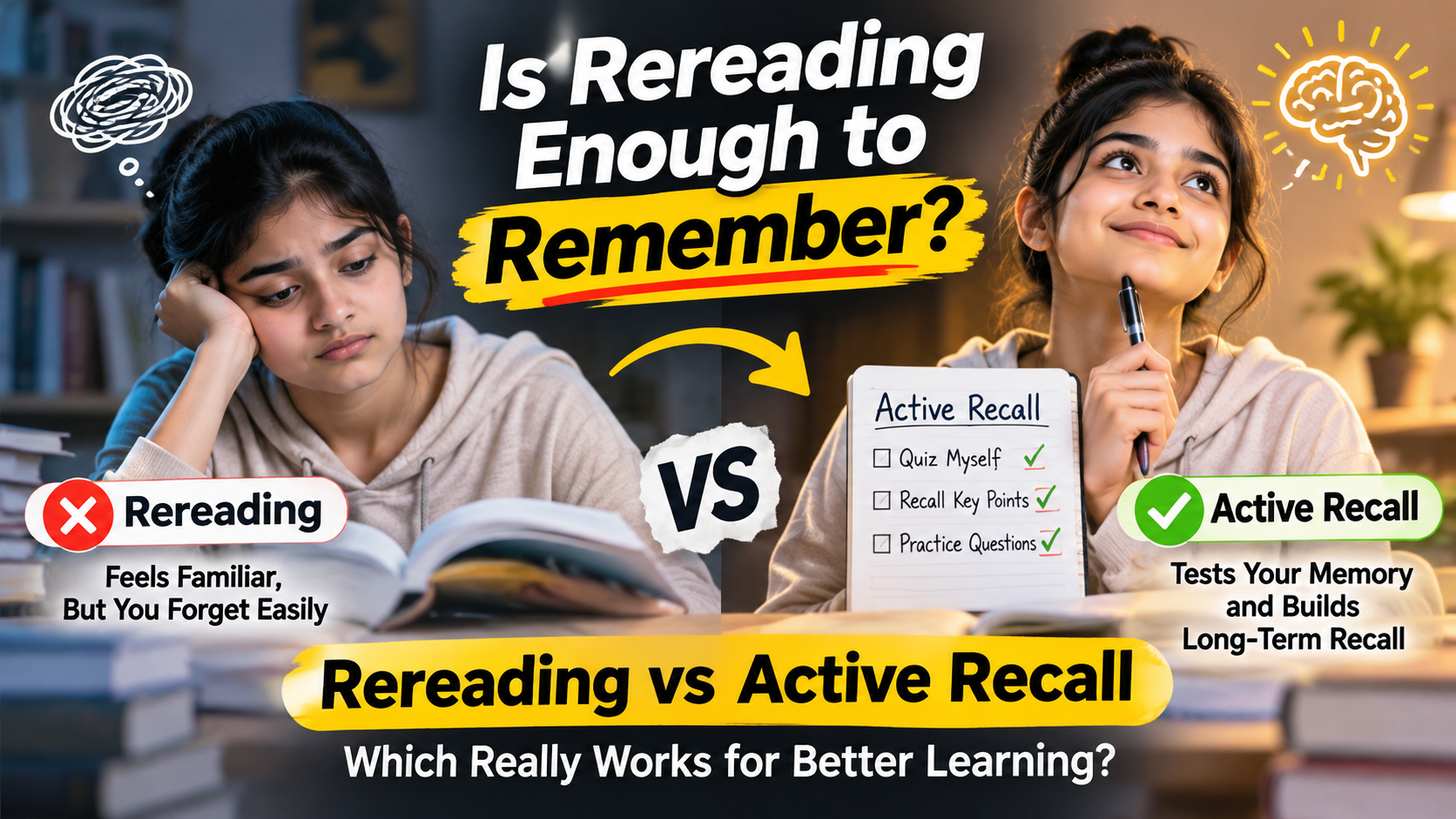
Re-reading notes can help students become familiar with a topic, but it is not always the most effective way to remember information for a long time. A more useful revision method is active recall, which means trying to remember information without looking at the textbook or notes. Combining active recall with selective rereading can help students identify gaps in their understanding and revise more effectively.
Many students spend hours highlighting textbooks, reading the same notes repeatedly and feeling that they know the chapter. But when they close the book and try to answer questions, they may struggle to remember important details. This happens because recognising information while reading is different from retrieving it independently.
Let's understand the difference between rereading and active recall, and how students can use both methods in their study routine.
What Is Rereading in Studying?
Rereading is the process of going through information you have already studied. Students commonly use it to revise textbook chapters, class notes, highlighted paragraphs and summaries.
For example, a student preparing for NEET may read the same Biology chapter several times before an examination. This can help refresh forgotten details and make the content feel familiar.
However, rereading has a limitation: seeing the correct answer in front of you does not necessarily mean you can remember it when the book is closed.
What Is Active Recall?
Active recall is a learning technique in which students deliberately try to retrieve information from memory without looking at the answer. Instead of reading the same paragraph again, they ask themselves questions and attempt to answer them independently.
For example, after studying a Biology topic, close the NCERT textbook and ask yourself:
What are the main points of this topic?
Can I explain the process in my own words?
Which important terms or examples do I remember?
Can I answer questions without checking my notes?
After attempting to answer, open the textbook and check what you remembered correctly and what you missed.
This process is also known as retrieval practice or practice testing. It gives students an opportunity to strengthen their ability to retrieve information and identify areas that need more revision.
Active Recall vs Rereading: What Is the Difference?
Both methods can be part of a study routine, but they serve different purposes. Rereading exposes you to the information again, while active recall asks you to produce the information from memory.
ComparisonRereadingActive RecallHow it worksReading previously studied information again.Remembering information without looking at it.Student activityReviewing notes or textbook content.Answering questions or explaining concepts from memory.Checking understandingCan make information feel familiar.Helps reveal what you can actually remember.Finding weak areasMay not clearly reveal forgotten information.Makes gaps in recall easier to identify.Best useRefreshing concepts and checking details.Practising retrieval and testing knowledge.
For most students, active recall is a valuable revision technique. However, rereading remains useful when you need to understand a difficult explanation, correct a mistake or revisit information you could not remember.
Why Can Rereading Feel Effective Even When You Forget Later?
One reason students rely heavily on rereading is that familiar information can feel easier to understand. When you see a paragraph several times, you may recognise the words and feel confident about the topic.
But recognition and recall are not the same.
Recognition means identifying information when you see it again. Recall means retrieving information without being shown the answer. Examinations often require students to recall facts, understand concepts and apply knowledge independently.
That is why students should not judge their preparation only by how familiar a chapter feels. They should also check whether they can explain it or answer questions without looking at the material.
What Does Research Say About Active Recall?
Research in cognitive psychology has repeatedly examined the benefits of retrieval practice and practice testing.
A well-known study by Roediger and Karpicke, published in 2006, compared repeated studying with retrieval practice. Their findings showed that practising retrieval helped improve long-term retention, even though students sometimes felt more confident after repeatedly studying the material.
A 2013 review by Dunlosky and colleagues evaluated several common learning techniques. Practice testing and distributed practice received stronger recommendations than techniques such as rereading and highlighting when considering their usefulness across different learning situations.
This does not mean rereading is useless. It means students should make room for activities that require them to retrieve information rather than relying only on repeated exposure.
How Can Students Practise Active Recall?
Active recall does not require complicated tools. Students can practise it using textbooks, notebooks, flashcards or simple questions.
1. Close Your Book and Explain the Topic
After completing a section, close your textbook and explain the main concept in your own words. Imagine that you are teaching the topic to a friend.
If you cannot explain a particular point, mark it for revision and check the textbook again.
2. Write What You Remember
Take a blank sheet of paper and write down everything you remember about a topic. Do not look at your notes while doing this.
Once you finish, compare your answers with the textbook. Add missing information and correct any mistakes.
3. Ask Yourself Questions
Turn important headings into questions. For example, instead of simply reading a heading about photosynthesis, ask yourself:
What is photosynthesis?
Where does it take place?
What are the main requirements?
What are its important stages?
Try answering each question before checking your notes.
4. Use Flashcards
Flashcards are useful for testing short pieces of information. Write a question on one side and its answer on the other.
Look at the question, attempt to answer it and then turn the card over to check your response. Separate the cards you find difficult so you can revisit them.
5. Solve Practice Questions
Multiple-choice questions, short-answer questions and previous examination questions can help you check your understanding.
Do not simply check whether your answer is correct. Understand why the correct option is right and why the other options are incorrect.
How Can NEET Aspirants Use Active Recall for Biology?
NEET Biology involves detailed concepts, terminology, examples, diagrams and processes. Students need to understand the NCERT content and remember important details accurately.
Here is a practical example of how to use active recall while revising Biology.
Step 1: Study a Small Section of NCERT
Choose one manageable section rather than trying to revise an entire chapter at once. Read it carefully and understand the meaning of the important terms.
Step 2: Close the Textbook
After studying the section, close NCERT and try to recall the main points. Write down important terms, examples and processes from memory.
Step 3: Check Against NCERT
Open the textbook and compare your answers with the original content. Identify missing facts, incorrect statements and concepts that need more attention.
Step 4: Practise MCQs
Attempt relevant questions from the topic. Review every incorrect answer and understand the reason behind the mistake.
Step 5: Revisit Difficult Information
Return to the points you found difficult after a suitable gap. Testing yourself again can help you check whether you can retrieve the information more successfully.
This approach can also be used for Chemistry definitions, Physics concepts and other subjects that require students to remember and apply information.
Can Students Combine Rereading and Active Recall?
Yes. Students do not need to stop reading their notes completely. The better approach is to use rereading when necessary and make active recall a regular part of revision.
For example, follow this simple sequence:
Read: Study a small topic from your textbook.
Recall: Close the book and explain what you remember.
Check: Compare your explanation with the original material.
Correct: Re-read the points you missed or misunderstood.
Test: Answer questions without looking at your notes.
Repeat later: Revisit the topic after a gap to check long-term recall.
This method makes revision more active and helps students use their study time more purposefully.
How Can Audio Learning Support Active Recall?
Audio learning can provide another way to revisit educational information. Students can listen to explanations or educational songs and then pause the audio to recall the information independently.
For example, after listening to an educational song about a familiar topic, try answering questions about its content without replaying it. You can also explain the concept aloud or write down the important points from memory.
NEET BAND offers a music-based approach to educational content. Students can explore its audio learning resources as an additional part of their revision routine.
However, listening should not replace independent recall, textbook study or question practice. The important step is checking what you can remember after the audio ends.
Explore NEET BAND or visit the Courses page to learn more.
Common Active Recall Mistakes Students Should Avoid
Looking at the answer too quickly: Give yourself enough time to attempt a response before checking your notes.
Only recalling easy topics: Include difficult concepts and weak areas in your practice.
Ignoring mistakes: Check why an answer was incorrect and revise the underlying concept.
Trying to memorise without understanding: First understand the topic, then practise recalling its important details.
Revising everything in one sitting: Spread practice across multiple sessions instead of depending on one long revision session.
Confusing familiarity with learning: Test yourself without looking at the material to check what you genuinely remember.
Frequently Asked Questions About Active Recall and Rereading
1. Is active recall better than rereading?
Active recall is generally more useful for practising long-term retrieval than simply reading the same information repeatedly. However, rereading is still useful for understanding difficult concepts and correcting mistakes.
2. Does rereading notes help students remember information?
Rereading can refresh information and improve familiarity with a topic. However, students should also test themselves without looking at their notes to check whether they can recall the information independently.
3. How do I start using active recall?
Study a small section, close your book and try to explain the topic from memory. Then check your answer against the textbook and revise the points you missed.
4. Is active recall useful for NEET preparation?
Yes. NEET aspirants can use active recall to revise Biology facts, Chemistry concepts and Physics principles. Combine it with NCERT study, MCQ practice and regular revision.
5. How many times should I practise active recall?
There is no fixed number that works for every student. Practise recalling information regularly and revisit difficult topics after a gap. Adjust your revision based on how well you remember the material.
6. Can I use flashcards for active recall?
Yes. Flashcards are a simple way to practise active recall. Read the question, try to answer it from memory and then check the answer on the other side.
7. Should I stop highlighting and making notes?
No. Highlighting and note-making can help organise information, but they should not be your only revision methods. Use your notes to understand concepts and then test yourself without looking at them.
Final Takeaway: Do Not Just Read It Again, Try to Remember It
Rereading notes can make information familiar, but familiarity does not always mean that you can remember it during an examination. Active recall encourages you to retrieve information independently and identify what you still need to learn.
Use rereading to understand and correct concepts. Use active recall to check your memory. Combine both with spaced revision and regular question practice to build a more effective study routine.
The next time you finish a chapter, do not immediately start reading it again. Close your book, ask yourself questions and see how much you can remember.
Explore NEET BAND
Looking for another way to revisit educational content? Explore music-based audio learning resources on NEET BAND.
Visit NEET BAND | Explore Courses | Contact Us
Research References
Roediger, H. L. III, and Karpicke, J. D. (2006). Test-Enhanced Learning: Taking Memory Tests Improves Long-Term Retention. Psychological Science. Read the research.
Dunlosky, J. et al. (2013). Improving Students' Learning With Effective Learning Techniques: Promising Directions From Cognitive and Educational Psychology. Psychological Science in the Public Interest. Read the research.
Karpicke, J. D., and Blunt, J. R. (2011). Retrieval Practice Produces More Learning than Elaborative Studying with Concept Mapping. Science. Read the research.
Comments (0)
Please log in to join the discussion.
No comments yet. Be the first to share your thoughts!