Do Songs Really Help You Remember Things Better?
Do Songs Really Help You Remember Things Better?
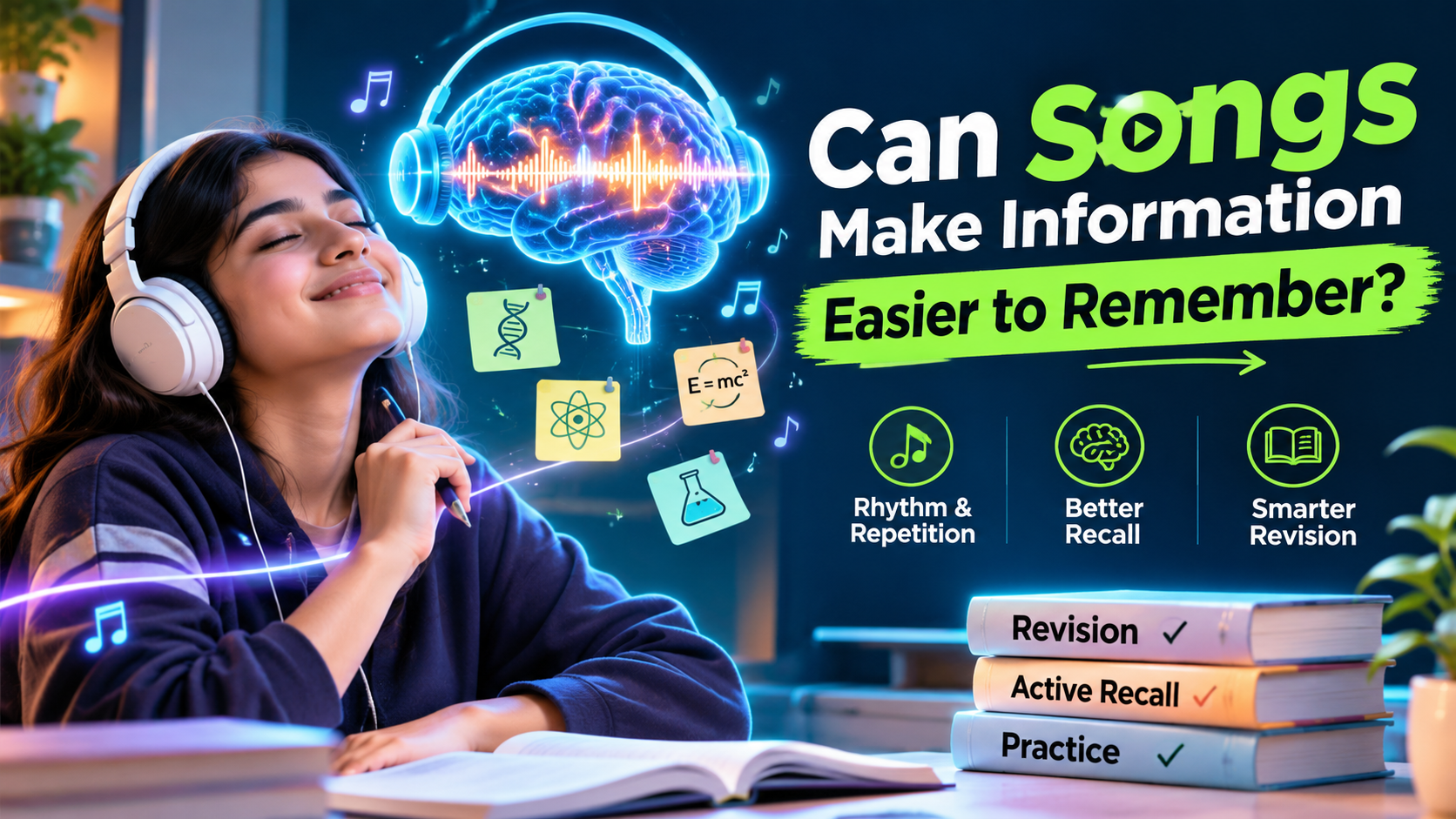
Yes, songs can sometimes make information easier to remember, especially when rhythm, repetition and meaningful lyrics are used to present it. This is why many people remember song lyrics long after hearing them. However, listening to a song does not automatically mean you have learned or understood the information. Students still need to practise recalling, explaining and applying what they hear.
From remembering the order of planets to learning scientific terms, songs can make certain types of information more engaging. But how does learning through songs work, and can students use it during school exams or competitive exam preparation? Let's explore.
Why Do We Remember Some Songs So Easily?
Think about a song you heard several years ago. You may still remember its tune or a few lines without making a conscious effort. This happens because songs combine several elements, including sound, rhythm, repetition and language.
These elements can provide additional cues that help us remember information.
1. Rhythm Creates a Pattern
Rhythm gives information a predictable structure. When words follow a regular beat, they may become easier to repeat and remember.
For example, students may find it easier to remember a short sequence when it is presented in a rhythmic pattern rather than as a random list. Rhythm can make information feel organised and easier to practise.
2. Repetition Strengthens Familiarity
Songs often repeat words, phrases and musical patterns. Repeated exposure can make information more familiar and provide additional opportunities to practise remembering it.
However, hearing the same information repeatedly is not the same as being able to recall it independently. Students should pause the song and try to remember the information without listening again.
3. Melody Provides an Additional Memory Cue
A melody can become connected with the words that accompany it. When students remember the tune, it may help them recall the associated information.
For example, a student who learns a short educational song about a sequence may use its melody as a reminder when revising that sequence later.
4. Meaningful Information Is Easier to Connect
Information becomes more useful when students understand what it means. A song that explains a concept in simple language may help students connect unfamiliar terms with a familiar pattern.
But a catchy tune cannot replace conceptual understanding. Students should always understand the meaning behind the lyrics.
What Does Research Say About Learning Through Songs?
Research on music and memory suggests that music can influence how people process and remember information. However, the results depend on what is being learned, how music is used and the individual learner.
It is important to distinguish between remembering a song and learning an academic concept. Remembering lyrics does not automatically prove that a student can explain a scientific process or solve an examination question.
Educational songs may be useful as an additional learning method, particularly when they present information clearly and encourage repetition. They should be combined with established learning practices such as retrieval practice, spaced revision and question-solving.
Can Educational Songs Help Students Remember School Subjects?
Educational songs can be used to present selected information from different subjects. They are most useful when the content is accurate, relevant and easy to understand.
1. Biology
Biology includes many scientific terms, processes, classifications and sequences. A carefully designed educational song may help students revisit selected terms or remember the order of a process.
For example, students can use a song as a revision cue for a sequence they have already studied. They should still refer to their textbook to understand the complete process.
2. Chemistry
Chemistry involves concepts, terminology, reactions and periodic trends. Rhythm and repetition may help students revisit selected facts, but they should not depend on songs alone to understand chemical reactions or solve numerical problems.
3. Physics
Physics requires conceptual understanding, mathematical application and problem-solving. Songs may help students remember selected definitions or formulas, but learning how and when to apply a formula requires practice.
4. History and Geography
Dates, names, locations and sequences can sometimes be organised into memorable patterns. Educational songs may provide an additional way to revise selected facts, while textbooks and maps remain important for deeper understanding.
How Can Students Use Songs to Improve Revision?
Students should use educational songs as a supporting revision method rather than as a replacement for reading and practice. Here is a simple approach:
Step 1: Understand the Topic First
Read the chapter or learn the concept from your teacher before listening to a related educational song. This helps you connect the song with information you already understand.
Step 2: Listen Carefully
Pay attention to the words and the meaning behind them. Do not treat the song only as background entertainment. Identify the important terms, facts or sequence being explained.
Step 3: Repeat the Important Information
Listen again when necessary. Repetition can provide another opportunity to become familiar with the material.
Step 4: Pause and Recall
Turn off the audio and try to explain the topic in your own words. Write down the important points without looking at your notes.
Step 5: Test Yourself
Answer textbook questions, practise multiple-choice questions or explain the concept to someone else. This helps you check whether you have actually learned the material.
Step 6: Revise After a Gap
Return to the topic after some time instead of listening to the same song continuously in one sitting. Spacing your revision gives you another opportunity to retrieve the information from memory.
Are Songs Better Than Reading for Learning?
No single learning method is best for every topic or student. Reading provides detailed explanations, diagrams and written information. Educational songs can offer an audio-based way to revisit selected concepts.
The two methods can complement each other.
Learning MethodHow It Can HelpWhat Students Should RememberReading textbooksProvides detailed explanations and structured information.Read actively and check your understanding.Educational songsPresent selected information through rhythm and repetition.Understand the lyrics instead of memorising sounds alone.Written notesHelp organise important facts and concepts.Use notes for revision, not just copying.Active recallEncourages students to retrieve information without looking.Practise explaining and remembering independently.Question practiceChecks understanding and application.Review mistakes and understand why an answer is correct.
Can NEET Aspirants Use Songs for Revision?
NEET aspirants can explore educational songs as an additional way to revise selected topics. However, NEET preparation requires much more than remembering facts. Students need conceptual clarity, NCERT-based learning, question practice and regular revision.
Here are some practical ways to include songs in a NEET study routine:
Revise familiar topics: Use educational songs to revisit concepts that you have already studied.
Remember selected sequences: Try songs that explain ordered steps or groups of related information.
Revisit important terms: Use audio revision to become familiar with scientific terminology.
Test your memory: After listening, close the book and try to recall the information.
Practise MCQs: Check whether you can apply the information to actual questions.
For detailed Biology chapters, students should continue using NCERT as their primary study reference. Educational songs can support revision, but they should never replace the original syllabus or textbook.
How NEET BAND Uses Music as a Learning Format
NEET BAND brings study content into a music-based audio learning format. Its approach is designed to give students another way to engage with educational topics through listening.
Students can explore audio-based study resources and use them alongside their regular learning routine. The idea is not to replace textbooks, teachers or question practice, but to provide an additional format for revisiting educational content.
Explore the platform at NEET BAND or visit the Courses page to learn more.
Common Mistakes to Avoid When Learning Through Songs
Listening without understanding: A student may remember the tune but fail to explain the concept.
Depending only on repetition: Replaying a song is not a substitute for independent recall.
Ignoring textbook information: Educational songs may simplify a topic, so check important details against reliable study material.
Using songs for every task: Difficult reading, detailed explanations and problem-solving may require silence.
Skipping question practice: Remembering a fact is different from applying it correctly in an examination.
Learning inaccurate lyrics: Always check the accuracy of educational content before relying on it.
Frequently Asked Questions About Songs and Memory
1. Do songs really help you remember things better?
Songs can provide memory cues through rhythm, melody and repetition. They may help students revisit selected information, but they do not guarantee better memory or understanding. Students should combine listening with recall and practice.
2. Why is it easier to remember song lyrics?
Song lyrics are connected with melody, rhythm and repeated musical patterns. These elements can provide additional cues that help people remember the words.
3. Can educational songs help students remember Biology?
Educational songs may help students revisit selected Biology terms, facts and sequences. However, students should use NCERT, diagrams, conceptual learning and question practice to understand the complete topic.
4. Is listening to a study song enough to learn a chapter?
No. Listening alone is not enough to master a chapter. Students need to understand the topic, revise important information, recall it independently and practise relevant questions.
5. Are songs useful for NEET preparation?
Songs can be an additional revision resource for selected topics. NEET aspirants should continue to prioritise NCERT study, conceptual understanding, regular revision and MCQ practice.
6. Should I listen to educational songs while reading?
It depends on the task. If the song distracts you from reading, use it separately as an audio revision activity. For detailed textbook reading, silence may be more suitable.
7. How often should I listen to educational songs?
There is no fixed number of times that works for everyone. Listen when it supports your revision, then test your recall after a gap. Focus on remembering the information independently rather than counting how many times you replay the song.
Final Takeaway: Use Songs as a Supportive Learning Tool
Songs can make selected information more engaging by combining rhythm, melody and repetition. These features may provide useful memory cues, particularly when educational content is presented clearly.
However, listening is only one part of learning. Students need to understand concepts, recall information without assistance and practise applying what they have learned.
Whether you are preparing for school examinations, NEET or JEE, use educational songs as one part of a balanced study routine. Combine audio learning with textbooks, active recall, spaced revision and question practice.
The goal is not simply to remember a song. The goal is to remember, understand and use what you have learned.
Explore NEET BAND
Want to explore a music-based approach to studying? Discover audio learning resources through NEET BAND.
Comments (0)
Comments are disabled for this article.