
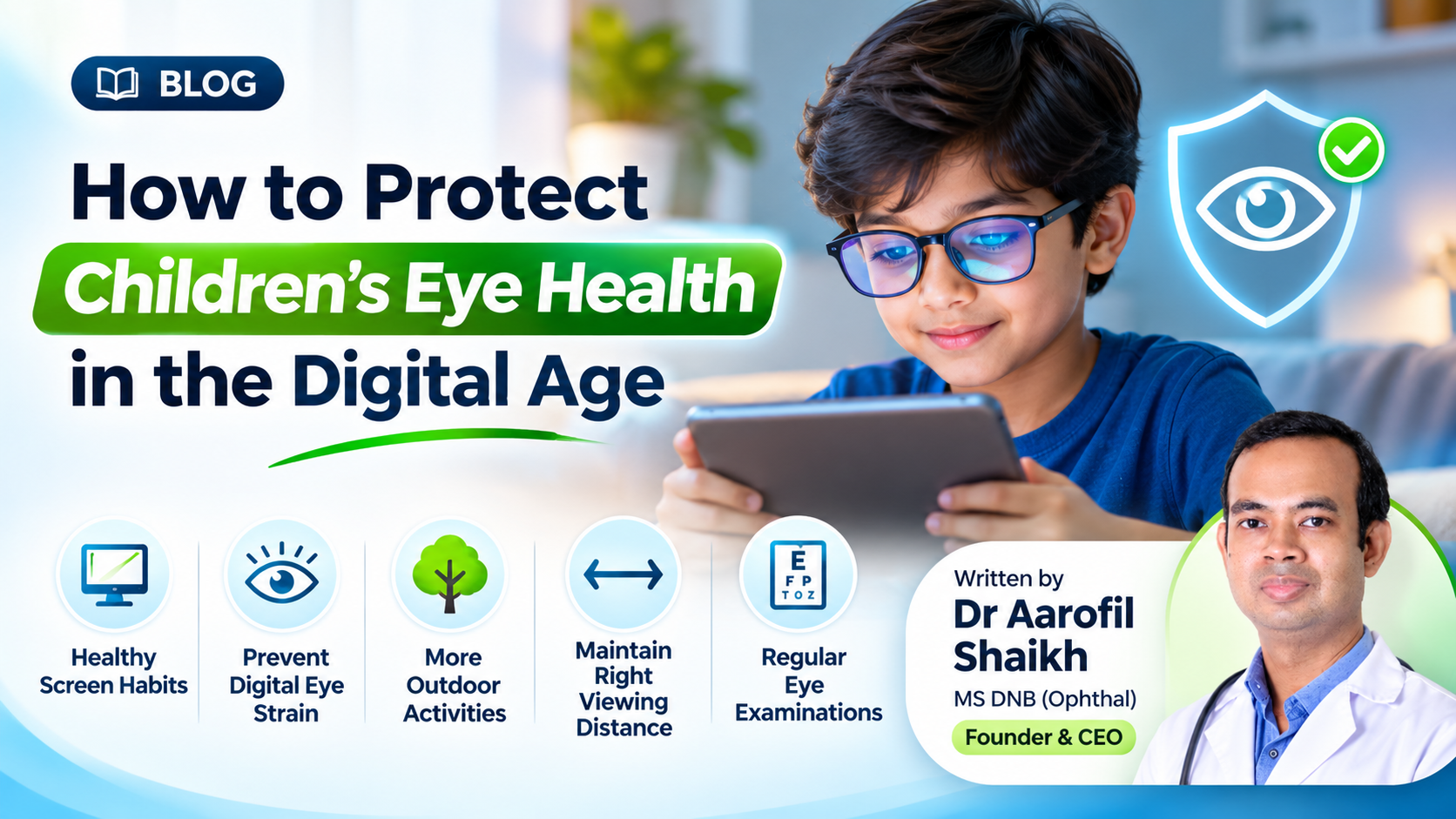
How to Protect Your Child's Eyes in the Age of Screens: A Parent's Guide
Children today use smartphones, tablets, computers, and televisions for education, entertainment, and communication. Although digital devices have become a regular part of childhood, spending long periods focusing on nearby screens can contribute to eye discomfort and may be associated with a higher risk of developing myopia (short-sightedness). Parents can support healthy vision by encouraging regular breaks, outdoor activities, comfortable screen habits, and timely eye examinations.
Why Is Children's Eye Health Important in the Digital Age?
Children's eyes are still developing, and their daily activities increasingly involve close-up work. From online classes and educational videos to mobile games and social media, screens have become part of many children's routines.
The concern is not simply that children look at screens. It is also how long they spend focusing on nearby objects, how frequently they take breaks, how much time they spend outdoors, and whether they maintain healthy daily habits.
Prolonged close-up screen use can contribute to digital eye strain. Children may experience tired eyes, dryness, headaches, or temporary blurred vision. Research has also found associations between extensive near work, time spent indoors, and childhood myopia.
However, it is important to understand that digital eye strain and myopia are different conditions. Temporary discomfort does not automatically mean that a child has developed permanent eye damage.
How Do Screens Affect Children's Eyes?
When children concentrate on a screen for a long time, they may blink less frequently and continue focusing at a close distance without taking sufficient breaks.
This can contribute to several types of discomfort.
1. Digital Eye Strain
Digital eye strain refers to eye discomfort associated with prolonged screen use and other sustained close-up activities.
Common symptoms may include:
Eye fatigue or tired eyes.
Dryness, irritation, or burning sensations.
Headaches after extended screen use.
Temporary blurred vision.
Difficulty maintaining comfortable focus.
These symptoms can also occur after prolonged reading or other close-up activities. If they continue or repeatedly return, parents should arrange an eye examination.
2. Childhood Myopia (Short-Sightedness)
Myopia is a vision condition in which distant objects appear blurry while nearby objects may remain clear.
It commonly develops during childhood and adolescence. Family history, prolonged near work, and limited outdoor time are among the factors associated with myopia.
Research suggests that spending more time outdoors can help reduce the risk of developing myopia in children. The relationship between screen use and myopia is more complex, so it would be inaccurate to say that screens alone directly cause the condition.
3. Disrupted Sleep Routines
Using digital devices close to bedtime can interfere with a child's sleep routine. Evening screen use may delay bedtime and expose children to stimulating content when they should be preparing to rest.
Healthy sleep is important for children's overall development, learning, and daily wellbeing. Parents can establish screen-free time before bedtime to encourage a more consistent sleep schedule.
How Can Parents Protect Their Children's Eyes From Screens?
Parents do not need to remove every digital device from their children's lives. Instead, they can introduce practical habits that encourage comfortable screen use and a healthier balance between digital and offline activities.
1. Follow the 20-20-20 Rule
One simple habit for reducing digital eye discomfort is the 20-20-20 rule.
Every 20 minutes of close-up screen use, take a break.
Look at something approximately 20 feet away.
Continue looking at it for at least 20 seconds.
Parents can remind younger children to follow this habit during online classes, homework, gaming, or other extended screen activities.
The 20-20-20 rule is a practical way to take visual breaks. It should not be treated as a proven method of preventing myopia.
2. Maintain a Comfortable Viewing Distance
Children often hold smartphones and tablets very close to their faces. Maintaining a comfortable viewing distance can help reduce the demands of prolonged close-up work.
Parents should encourage children to:
Keep smartphones and tablets at least around 12 inches (30 cm) away where practical.
Keep larger computer screens approximately an arm's length away when possible.
Avoid holding devices extremely close to the eyes.
Use a suitable stand for tablets during longer learning sessions.
Increase text size instead of bringing the screen closer.
The correct distance can vary with the device, screen size, and child's comfort. Children should not need to lean forward or strain to read.
3. Encourage More Outdoor Activities
Outdoor time is an important part of a healthy childhood. Spending time outside gives children an opportunity to participate in physical activities and look at objects at different distances instead of continuously focusing on nearby material.
Evidence suggests that regular outdoor time can help reduce the risk of developing myopia. Many eye-health resources encourage children to spend around one to two hours outdoors daily where practical, depending on age, circumstances, and professional guidance.
Parents can encourage activities such as:
Playing outdoor games.
Walking or cycling with family.
Playing sports.
Spending time in parks and open spaces.
Participating in outdoor school activities.
Outdoor activities should be planned with appropriate sun protection, hydration, and safety measures.
4. Create a Screen-Friendly Study Environment
The environment in which children use digital devices can influence their comfort.
Parents should check that:
The room has comfortable and adequate lighting.
There is no distracting glare on the screen.
The screen brightness is suitable for the surroundings.
The child is sitting comfortably with good posture.
The device is positioned so the child does not need to bend forward continuously.
A comfortable study environment can make long learning sessions easier to manage.
5. Encourage Regular Blinking
People generally blink less frequently when concentrating on screens. Reduced blinking can contribute to dryness and irritation because blinking helps spread tears across the eye's surface.
Encourage children to blink naturally and take regular visual breaks. If dryness or irritation continues, consult an eye specialist rather than independently using medicated eye drops.
6. Avoid Screens Before Bedtime
Make the period before bedtime an opportunity to disconnect from digital devices.
Children can use this time for reading printed books, drawing, talking with family, listening to suitable stories, or preparing for the next day.
A consistent bedtime routine can support healthier sleep habits and reduce unnecessary late-night screen use.
7. Balance Digital Learning With Offline Activities
Educational technology can be useful, but children do not need to complete every learning activity on a screen.
Parents can balance digital lessons with:
Printed textbooks and notebooks.
Handwritten practice and homework.
Physical flashcards and educational games.
Audio lessons and study songs.
Discussion and explanation-based learning.
Outdoor activities and recreational play.
Choosing the right learning format for each activity can help children develop a more balanced routine without unnecessarily depending on continuous screen use.
How Much Screen Time Is Appropriate for Children?
Parents often ask how many hours of screen time are safe for their children. There is no single number that applies equally to every child, age group, and situation.
Screen use should be considered in the context of the child's age, the type of content, sleep, physical activity, schoolwork, family interaction, and overall development.
The American Academy of Pediatrics recommends prioritising healthy activities and considering the quality and context of digital media use rather than relying only on a universal time limit for every child.
For younger children, parents should follow age-appropriate guidance and prioritise real-world interaction, play, sleep, and family engagement.
For school-going children and teenagers, families can establish practical screen boundaries that protect time for homework, physical activity, hobbies, sleep, and social interaction.
Are Blue Light Glasses Necessary for Children?
Blue-light glasses are often marketed as a solution for protecting children's eyes from digital screens. However, parents should understand what current evidence actually says.
The American Academy of Ophthalmology states that the amount of blue light emitted by digital screens has not been shown to cause eye disease or permanent damage to the eyes.
Digital eye discomfort is generally associated with factors such as prolonged close-up work, reduced blinking, and unsuitable viewing habits rather than screen blue light alone.
Blue-light filtering glasses have not been established as a necessary way to prevent screen-related eye damage in children. Parents should consult an eye specialist before purchasing special glasses for a child.
What Are the Warning Signs of Vision Problems in Children?
Children may not always realise that their vision is unclear. Some may assume that everyone sees the world in the same way they do.
Parents should pay attention to changes in behaviour and possible vision-related symptoms.
Frequently rubbing or squeezing the eyes.
Squinting while looking at distant objects.
Holding books or devices unusually close.
Complaining of frequent headaches or eye discomfort.
Difficulty seeing the classroom board.
Closing one eye to focus.
Frequently losing interest in activities that require seeing clearly.
Tilting the head or covering one eye while looking at something.
These signs do not automatically confirm an eye condition, but they should not be ignored.
If a child experiences sudden vision loss, sudden double vision, severe eye pain, or an eye injury, seek urgent medical attention.
Why Are Regular Eye Examinations Important?
Regular eye examinations help identify vision problems that may not be obvious at home or in the classroom.
A child may have difficulty seeing distant objects without clearly communicating the problem. An eye examination can help identify refractive errors, including myopia, and determine whether corrective lenses or further assessment are needed.
Parents should follow age-appropriate vision screening and comprehensive eye examination recommendations from their paediatrician or eye specialist. Children with symptoms, a family history of eye conditions, or existing vision problems may need more frequent assessments.
Do not wait for a child to complain before paying attention to their vision.
How Can Parents Build Healthy Eye-Care Habits at Home?
Protecting children's vision is not a one-day activity. It is about creating everyday habits that children can understand and follow as they grow.
Here is a simple routine parents can encourage:
Morning: Include outdoor activity or play when practical.
During study: Maintain a comfortable viewing distance and take regular breaks.
After school: Balance homework with physical activity and recreation.
During entertainment: Set reasonable boundaries for gaming and videos.
Before bedtime: Keep devices away and encourage relaxing offline activities.
Regularly: Follow recommended eye examinations and consult an ophthalmologist if concerns arise.
Children learn habits by observing adults. Parents who also practise balanced screen use can make these changes easier for the entire family.
Learn More About Children's Eye Health Through Dr. Aarofil Shaikh's Book
Understanding children's eye health is an important responsibility for every parent, especially when digital devices have become a regular part of education and everyday life.
To help parents learn more about protecting children's vision, Dr. Aarofil Shaikh, Founder of NEET BAND and a Consultant Ophthalmologist and Eye Surgeon, has authored a book titled:
How to Protect Your Child's Eyes
The book offers parents an opportunity to explore children's eye health and understand why developing healthy eye-care habits from an early age matters.
If you are a parent, caregiver, or someone interested in children's vision, you can explore the book and learn more about the subject.
How to Protect Your Child's Eyes
Written by Dr. Aarofil Shaikh
Founder of NEET BAND | Consultant Ophthalmologist and Eye Surgeon
Make children's eye health a priority. Explore the book and learn more about protecting your child's vision in today's digital environment.
How Does NEET BAND Encourage Healthier Learning Habits?
At NEET BAND, the focus is on making learning and revision more engaging through educational audio, curriculum-aligned study songs, notes, and quizzes.
Audio-based learning gives students another way to revisit familiar concepts without continuously looking at a screen. It can be included alongside textbooks, classroom teaching, written practice, and other traditional learning activities.
This approach supports a more flexible learning routine in which students can use different formats for different study activities.
Explore the available learning resources through the NEET BAND Courses page or learn more about the platform on the About NEET BAND page.
Have Questions About NEET BAND?
Connect with our team to learn more about audio learning, study songs, and educational resources for students.
Frequently Asked Questions About Children's Eye Health
How can I protect my child's eyes from mobile screens?
Encourage regular screen breaks, maintain a comfortable viewing distance, avoid unnecessary prolonged close-up use, promote outdoor activities, and arrange regular eye examinations. These habits can help support comfortable screen use and healthy vision.
Does mobile screen use cause permanent eye damage in children?
Normal digital screen use has not been established as a direct cause of permanent eye damage. However, prolonged close-up screen use can contribute to temporary eye discomfort, and extensive near work is associated with myopia risk. Healthy viewing habits and appropriate eye care remain important.
What is the 20-20-20 rule for children's eyes?
The 20-20-20 rule suggests that after every 20 minutes of close-up screen use, a person should look at an object approximately 20 feet away for at least 20 seconds. It is a simple habit that may help reduce digital eye strain.
How much outdoor time should children get for healthy eyes?
Regular outdoor activity is associated with a lower risk of childhood myopia. Many eye-health organisations encourage around one to two hours of outdoor time daily where practical. The appropriate routine should also consider the child's age, safety, and individual needs.
Can blue-light glasses protect children's eyesight?
There is currently no strong evidence that blue-light filtering glasses prevent digital eye strain or protect children from screen-related eye damage. Parents should seek professional advice before purchasing special eyewear.
When should a child visit an eye specialist?
Children should receive age-appropriate vision screening and eye examinations. Parents should consult an eye specialist if a child frequently squints, holds objects very close, complains of headaches or eye discomfort, or has difficulty seeing clearly.
Who wrote the book How to Protect Your Child's Eyes?
The book How to Protect Your Child's Eyes is written by Dr. Aarofil Shaikh, Founder of NEET BAND and a Consultant Ophthalmologist and Eye Surgeon. Parents can explore the book on Amazon.
Buy How to Protect Your Child's Eyes on Amazon
Final Thoughts: Protecting Children's Eyes Starts With Everyday Habits
Digital devices are now part of children's education and daily lives. The goal should not be to eliminate technology completely, but to help children use it responsibly while maintaining healthy visual habits.
Regular breaks, comfortable viewing distances, outdoor activities, balanced screen routines, adequate sleep, and timely eye examinations can all contribute to better eye-care habits.
Most importantly, parents should take children's vision concerns seriously and seek professional advice whenever necessary.
As Dr. Aarofil Shaikh highlights through his work in ophthalmology and NEET BAND's focus on student wellbeing, healthy learning habits and eye care deserve attention from an early age.
Explore the book How to Protect Your Child's Eyes on Amazon and take another step towards understanding your child's eye health.
Follow NEET BAND on Instagram for more student learning and wellbeing updates.
References and Further Reading
American Academy of Ophthalmology – Screen Time and Kids' Eye Health
American Academy of Ophthalmology – Computers, Digital Devices, and Eye Strain
American Association for Pediatric Ophthalmology and Strabismus – Screen Time and Online Learning
American Academy of Pediatrics – Myopia in Children and Teens
Comments (0)
Comments are disabled for this article.