
How Do Study Songs Help Students Learn and Revise Better?
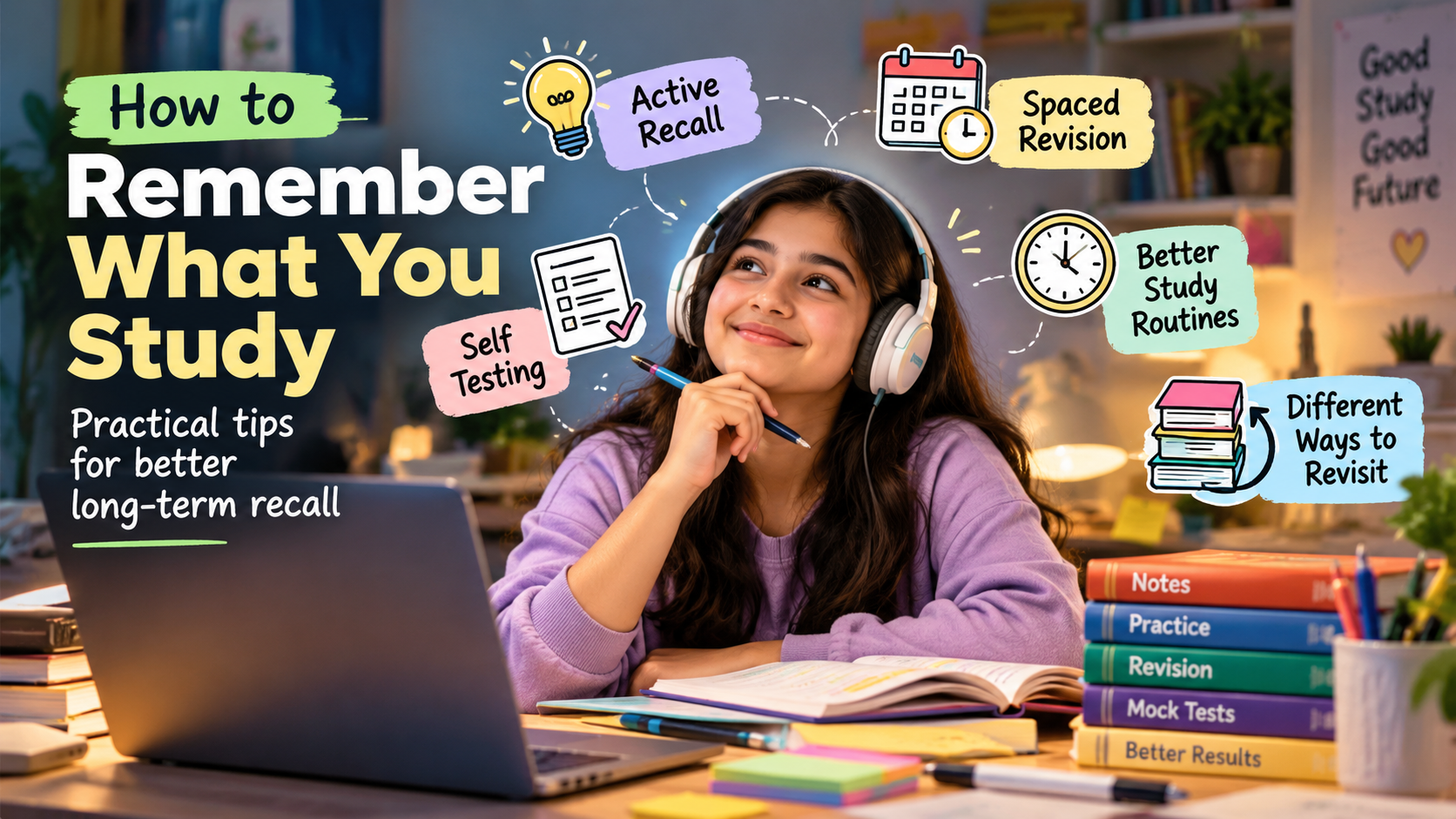
Remembering what you study for longer is not simply about spending more hours with your books. Students are more likely to retain learning when they actively recall information, revisit important topics over time, practise what they have learned, and check what they can remember without looking at the answer. A consistent revision routine can make this process more effective and reduce dependence on last-minute cramming.
Why Do Students Forget What They Study?
Forgetting is a normal part of learning. A student may understand a topic during a study session but struggle to recall it several days later. This is one reason revision should not be treated as something that happens only immediately before an examination.
Another common problem is confusing familiarity with actual recall. When students repeatedly read the same chapter, the information can start to look familiar. But recognising information on a page is different from being able to retrieve it independently.
A better approach is to regularly ask yourself what you can remember without looking at your notes.
How Can Students Remember What They Study for Longer?
Students can improve their ability to remember information by combining active recall, spaced revision, practice, explanation, and self-testing. Instead of trying to memorise everything in one long session, revisit important information across multiple study sessions and use different activities to check understanding.
1. Use Active Recall
Active recall means trying to retrieve information from memory before checking the answer.
After studying a topic, close your textbook or notes and ask yourself:
What were the main ideas?
Which important facts do I remember?
Can I explain the concept without looking?
Can I write down the important steps or formulas?
Once you have attempted to recall the information, check your notes and identify anything you missed.
This changes revision from simply looking at information to actively retrieving it.
2. Revise at Different Times
Instead of studying a topic once and leaving it until the examination, return to it at different points in your preparation.
For example, after learning a topic, you might revisit it later in the week and then return to it again during a subsequent revision cycle. The exact timing can depend on the subject, difficulty of the topic, and how confidently you can recall it.
Topics that you repeatedly forget can be given more attention than topics you already remember confidently.
3. Turn Your Notes into Questions
One simple way to make revision more active is to convert important information into questions.
Instead of reading:
“Photosynthesis is the process through which green plants make food using light energy.”
Ask:
“What is photosynthesis and what role does light energy play in the process?”
Then try to answer without looking at your notes.
The same approach can be used for definitions, formulas, processes, historical events, scientific concepts, and other subjects.
4. Explain What You Have Learned
Try explaining a topic as though you are teaching it to someone who has never studied it before.
Use your own words rather than repeating sentences directly from the textbook.
If you cannot explain an important part clearly, that can show you where your understanding needs more work.
5. Practise Instead of Only Reading
Practice gives students an opportunity to apply what they have learned. This is particularly important for subjects where understanding needs to be demonstrated through questions or problems.
After studying a topic, solve relevant questions without immediately checking the solution.
When you make a mistake, do not simply write down the correct answer. Try to understand why the mistake happened.
Why Is Self-Testing Important?
Self-testing can help students discover what they actually remember. A student may feel confident while reading notes but discover gaps when asked to answer questions without looking at the material.
Tests do not have to be formal examinations. They can be simple activities such as:
Answering five questions from memory
Writing the main points of a chapter on a blank page
Explaining a concept aloud
Solving a few practice problems
Using flashcards
Taking a short quiz
The important part is attempting to retrieve the information before checking the answer.
How Can Students Remember Difficult Topics?
Difficult topics often need to be broken into smaller parts. Instead of trying to memorise an entire chapter at once, identify the concepts that make up the chapter.
You might separate a topic into:
Key definitions
Main concepts
Important examples
Formulas or processes
Common mistakes
Questions that need additional practice
Work through these sections individually and then connect them together once you understand each part.
Can Short Study Sessions Help with Memory?
Short, focused sessions can make it easier to organise revision and return to topics regularly. The ideal length is not the same for every student.
Rather than deciding that every revision session must last for a fixed number of hours, choose a specific goal. You might revise one concept, solve a set of questions, or review mistakes from a previous session.
A clear objective can make it easier to know what you are trying to accomplish.
Can Audio Learning Help Students Remember What They Study?
Audio can be used as an additional way to revisit familiar learning content. Students can listen to suitable explanations, audio lessons, or study songs after they have already studied the underlying topic.
This can be useful when students want another way to revisit information without continuously reading from a screen or textbook.
However, listening should not be confused with proving that you can recall or apply information. Students should still use questions, written practice, discussion, and self-testing when the subject requires them.
NEET BAND uses curriculum-aligned study songs and audio learning alongside other resources such as notes, Q&A content, and quizzes. Students can explore the NEET BAND Courses to learn more about its available learning resources.
Can Students Use Audio to Revise While Travelling?
Suitable travel time can sometimes provide an opportunity for light revision when the student is travelling as a passenger and listening is safe and practical.
Students can use this time to revisit familiar concepts, definitions, summaries, or study songs. It can add flexibility to a study routine without requiring continuous visual attention.
Travel-based audio revision should still be treated as supplementary. Difficult new topics may require a focused environment with textbooks, notes, diagrams, and problem-solving.
How Can Students Remember More Without Studying All Day?
Remembering more does not necessarily mean studying continuously for longer hours. The quality and structure of revision matter.
A balanced revision cycle can look like this:
Learn: Understand the concept properly.
Recall: Close the material and retrieve what you remember.
Practise: Apply the concept through questions or problems.
Check: Identify mistakes and gaps.
Revisit: Return to the topic after some time.
Test: Check whether you can now recall and apply it independently.
This approach helps turn revision into an ongoing process rather than a single activity before an examination.
How Can NEET and JEE Students Improve Long-Term Recall?
Students preparing for NEET and JEE have a large amount of material to learn and revise. A useful approach is to divide the syllabus into manageable topics and regularly test both knowledge and application.
Students can combine:
Concept revision
Active recall
Formula and definition review
Question practice
Error analysis
Spaced revision
Short self-tests
Suitable audio-based revision
The balance can change during preparation. A student learning a topic for the first time may need more concept study, while a student revising the syllabus may need more retrieval and question practice.
What Should Students Do When They Keep Forgetting the Same Topic?
Repeatedly forgetting a topic is useful information. It may mean the concept needs to be understood more clearly, retrieved more frequently, or practised in a different way.
Start by identifying exactly what you are forgetting. Is it the definition, the sequence, the formula, the application, or the connection between concepts?
Once the problem is identified, choose the appropriate method. You might explain the concept aloud, create questions, solve more examples, review a short note, or revisit an audio resource before testing yourself again.
How Can Parents Help Children Remember What They Study?
Parents can support children by asking them to explain what they have learned rather than simply asking whether their homework is finished.
Simple questions can include:
What did you learn today?
Can you explain it in your own words?
Which part was difficult?
What do you remember without looking at the book?
Parents can also encourage regular routines, appropriate breaks, enough sleep, and a balanced approach to study. The goal is to support learning without turning every conversation into a test.
What Is a Simple Daily Memory-Friendly Revision Routine?
Students who want a simple routine can try the following:
Choose one specific topic to revise.
Review the important concepts.
Close the material and recall what you remember.
Answer a few questions.
Check and understand your mistakes.
Make a short note of anything you repeatedly forget.
Return to the topic during a later revision session.
The routine can be adjusted according to the student's age, subject, workload, and examination schedule.
Where Does NEET BAND Fit into Better Recall?
NEET BAND is designed as a supplementary learning platform combining curriculum-aligned study songs and audio learning with notes, Q&A resources, and quizzes.
Different resources can serve different parts of revision. Students may use notes to understand a topic, quizzes to test recall, and audio-based resources to revisit familiar learning content.
To explore the available learning options, visit the NEET BAND Courses.
You can also learn more about the platform through the NEET BAND About page.
Frequently Asked Questions
How can I remember what I study for longer?
Use active recall, spaced revision, practice questions, explanation, and regular self-testing. Instead of only rereading, repeatedly try to retrieve and apply what you have learned.
Why do I forget what I studied after a few days?
Forgetting is a normal part of learning. If information is not revisited or retrieved, it can become harder to recall. Regular revision and self-testing can help identify and strengthen areas that are difficult to remember.
Is rereading a chapter enough to remember it?
Rereading can be useful, but it does not by itself show whether you can retrieve the information later. Combining reading with active recall, questions, and practice gives you a clearer picture of what you actually remember.
Can listening help with remembering what I study?
Audio can be a useful supplementary way to revisit familiar learning content. It should be combined with active recall, practice, and self-testing when you need to check actual understanding and application.
How can I improve my memory for NEET and JEE preparation?
Build a consistent revision system around concept understanding, active recall, spaced revision, question practice, error analysis, and self-testing. Focus extra attention on topics that you repeatedly struggle to recall or apply.
Quick Takeaway
Remembering what you study for longer is less about repeatedly reading and more about actively retrieving and revisiting information. Learn the concept, close the book, recall what you remember, practise questions, check your mistakes, and return to difficult topics over time.
Different learning formats can also support this process. Audio learning and study songs can provide another way to revisit familiar content, while textbooks, teachers, written practice, and quizzes remain important parts of a complete learning routine.
Want to Explore NEET BAND?
Have questions about NEET BAND courses, study songs, or audio-based revision?
Follow NEET BAND on Instagram for study-related content and updates.
Comments (0)
Comments are disabled for this article.