
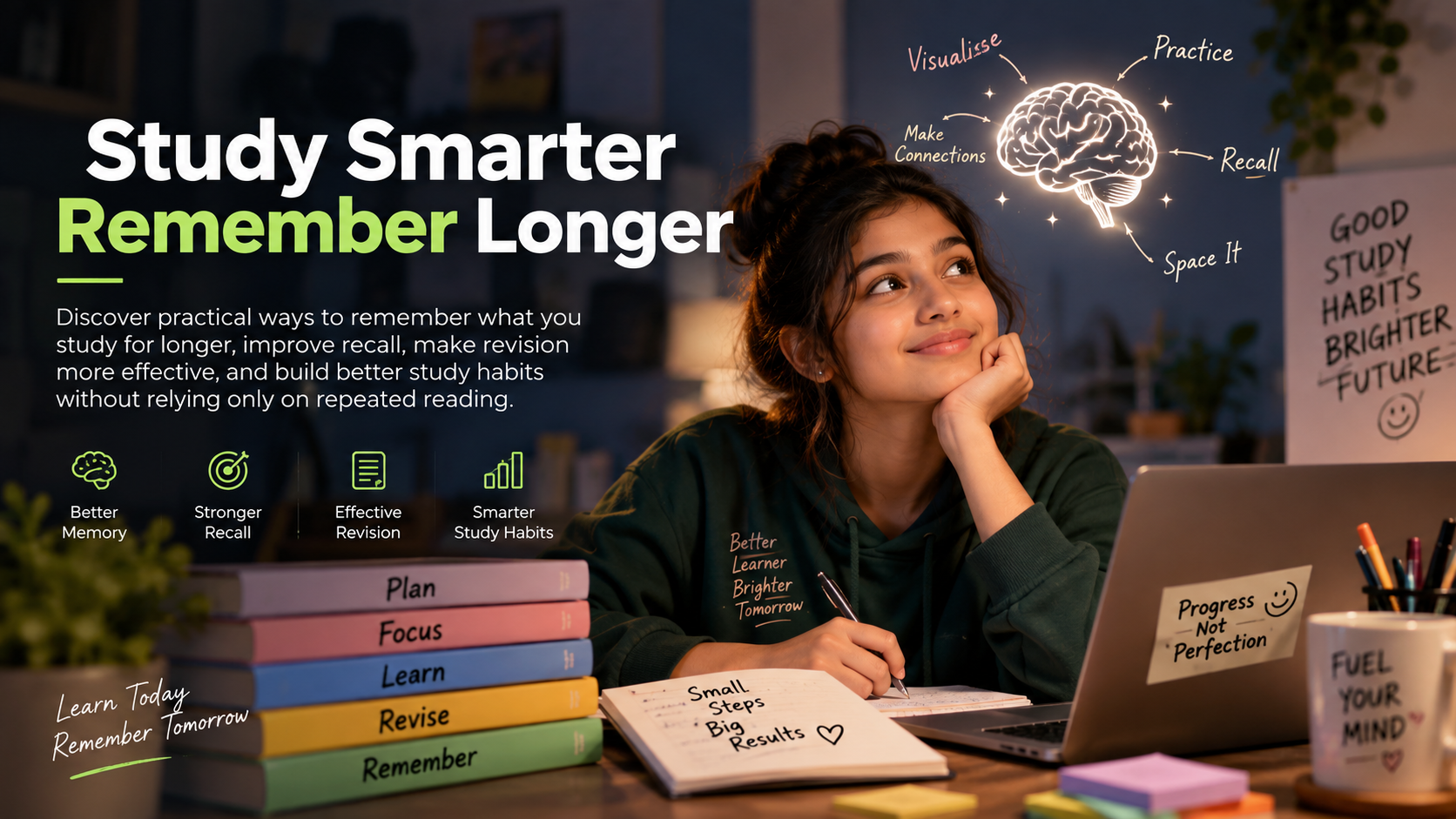
How Can Students Remember What They Study for Longer?
Remembering what you study for longer is less about studying for more hours and more about how you revise. Students can improve recall by actively testing themselves, revisiting important topics at spaced intervals, explaining concepts in their own words, and connecting new information with what they already know. A consistent revision routine can make learning more durable and reduce the need for last-minute cramming.
Why Do Students Forget What They Study?
Forgetting is a normal part of learning. A student may understand a chapter while studying it and still struggle to recall the same information a few days later. This often happens because reading something repeatedly can create a feeling of familiarity without giving the brain enough opportunities to retrieve the information independently.
The goal of effective revision is therefore not simply to look at the same material again. Students should also practise bringing information back to mind without immediately looking at the answer.
How Can Students Remember What They Study for Longer?
Students can improve long-term recall by combining active recall, spaced revision, self-testing, clear explanations, and regular practice. Instead of trying to memorise everything in one sitting, break learning into manageable sessions and return to important concepts over time.
1. Use Active Recall Instead of Only Rereading
Active recall means trying to remember information without looking at the study material first. After completing a topic, close the book and ask yourself questions such as:
What were the main ideas in this chapter?
Can I explain this concept without looking at my notes?
What formula, definition, process, or fact do I remember?
Can I answer a question about this topic on my own?
This simple change makes revision more active. Research reviewed by the U.S. Department of Education's What Works Clearinghouse has found evidence supporting retrieval-practice approaches for learning. In one reviewed randomized study, students using retrieval practice performed better on a later test than students using several comparison study approaches.
2. Revise the Same Topic at Different Times
Instead of studying a chapter once and leaving it until the examination, revisit it after some time. This is commonly described as spaced practice or spaced revision.
For example, a student might review a new topic today, test their recall after a couple of days, and revisit the important points again later. The exact schedule can vary depending on the subject, difficulty, and examination timeline, but the important idea is to spread learning and retrieval across multiple sessions.
Research from the Institute of Education Sciences has examined spacing and long-term retention, with findings showing that distributing practice over time can support better retention than concentrating practice into a single session.
3. Turn Chapters into Questions
Questions give students a practical way to check whether they actually remember something.
After studying a chapter, turn important headings and concepts into questions. For example:
What is photosynthesis?
Why is chlorophyll important?
What are the stages of the process?
What happens when one part of the process changes?
Answer the questions without immediately checking your notes. Then compare your answer with the study material and identify what you missed.
This approach also makes quizzes and self-assessment more meaningful because students are not simply checking whether an answer looks familiar; they are actively attempting to retrieve it.
4. Explain the Concept in Your Own Words
One useful way to check understanding is to explain a concept as if you were teaching it to another student. Avoid copying textbook sentences. Instead, describe the idea using simple language.
If you cannot explain a concept without repeatedly looking at your notes, that is a useful signal that the topic needs another round of learning or revision.
5. Break Large Topics into Smaller Parts
Large chapters can feel difficult to remember when students try to memorise everything together. Breaking a topic into smaller sections can make revision easier to organise.
A chapter can be divided into:
Key definitions
Main concepts
Important examples
Formulas or processes
Frequently tested questions
Points that are easy to confuse
Students can then revise each part separately before connecting the ideas together.
6. Mix Reading with Recall and Testing
Reading is an important part of learning, but revision does not have to stop at reading. A simple study cycle can be:
Learn the topic.
Close the material.
Recall the main points.
Answer a few questions.
Check mistakes.
Revisit the topic later.
This creates multiple opportunities to interact with the same information in different ways.
Can Audio Learning Help Students Revise?
Audio can be useful when students want to revisit familiar concepts without continuously looking at a screen. Audio-based revision can be particularly practical during short breaks, while travelling, or when students are moving between activities.
Audio should not be treated as a replacement for textbooks, teachers, problem-solving, or written practice. Instead, it can work as an additional revision format, especially for reviewing information that has already been learned.
NEET BAND uses curriculum-aligned study songs and audio learning as part of a broader learning system that also includes notes, Q&A resources, and quizzes. Students can explore and use them as a supplementary way to revisit learning content.
How Can Students Build a Better Revision Routine?
A good revision routine does not have to be complicated. The most important thing is to make it realistic enough to follow consistently.
A Simple Daily Revision Routine
Learn: Study one concept or section with proper attention.
Recall: Close the material and remember the key points.
Test: Answer a few questions without looking at the solution.
Correct: Check what you missed or misunderstood.
Revisit: Return to the topic during a later revision session.
Students can adjust the length of each step according to their class, subject, and workload. The objective is to make revision a regular process rather than something reserved for the days immediately before an examination.
What About Students Preparing for NEET and JEE?
Students preparing for competitive examinations such as NEET and JEE often have large amounts of syllabus content to revise. In such cases, remembering information requires more than simply completing chapters.
A practical revision system can combine concept learning, question practice, active recall, spaced revision, error review, and regular self-assessment. Students should also distinguish between knowing an answer and being able to apply a concept to a new question.
Short revision sessions can also be used between longer study blocks. Audio-based revision can be one additional format for revisiting familiar concepts when students are away from their books or want a break from continuous screen-based study.
How Can Parents Help Children Remember What They Study?
Parents can support learning without turning every study session into a test. Simple questions can help children explain what they have learned:
What did you learn today?
Can you explain that concept to me?
Which part was difficult?
What do you remember without checking your book?
Parents can also encourage regular sleep, breaks, organised study routines, and reasonable study goals. The aim should be to create an environment where children can practise and improve rather than feel that every study session must be perfect.
Where Does NEET BAND Fit into a Student's Revision Routine?
NEET BAND is designed as a supplementary learning and revision resource. Its learning ecosystem combines curriculum-aligned study songs and audio lessons with chapter-wise resources, Q&A content, and quizzes.
Students interested in different study approaches can also explore for practical study and revision guidance.
The platform is not intended to replace school teaching, textbooks, or regular question practice. Instead, audio and other resources can be incorporated into a wider study routine according to a student's needs.
Frequently Asked Questions
What is the best way to remember what you study?
There is no single method that works identically for every student. Active recall, spaced revision, self-testing, explanation, and regular practice are useful strategies for improving retention and recall.
Why do I forget what I studied the next day?
Forgetting some information after studying is normal. A topic may need to be retrieved and revised several times over different sessions before it becomes easier to recall. Regular spaced revision can help reduce dependence on last-minute studying.
Is rereading enough to remember a chapter?
Rereading can help students become familiar with material, but it does not by itself show whether they can retrieve the information later. Combining reading with recall questions, quizzes, or practice tests provides another way to check learning.
Can listening help with revision?
Audio can be used as a supplementary revision format, particularly for revisiting familiar concepts when students are travelling or taking a break from continuous screen use. It works best as part of a broader learning routine rather than as the only study method.
How often should students revise a topic?
Revision frequency depends on the subject, difficulty of the material, and the student's examination schedule. Instead of relying on one fixed timetable, students can revisit important topics across multiple sessions and use self-testing to identify which areas need more practice.
Quick Takeaway
If you want to remember what you study for longer, focus on how you revise, not just how long you study. Learn the concept, close the book, recall what you remember, test yourself, correct mistakes, and return to important topics over time.
The right combination of active recall, spaced revision, practice, and different learning formats can make revision more structured and purposeful. For students who want to add audio-based revision to that routine, NEET BAND provides curriculum-aligned study songs and supplementary learning resources.
```
Comments (0)
Please log in to join the discussion.
No comments yet. Be the first to share your thoughts!