What Is Audio Learning and How Does It Work for Students?
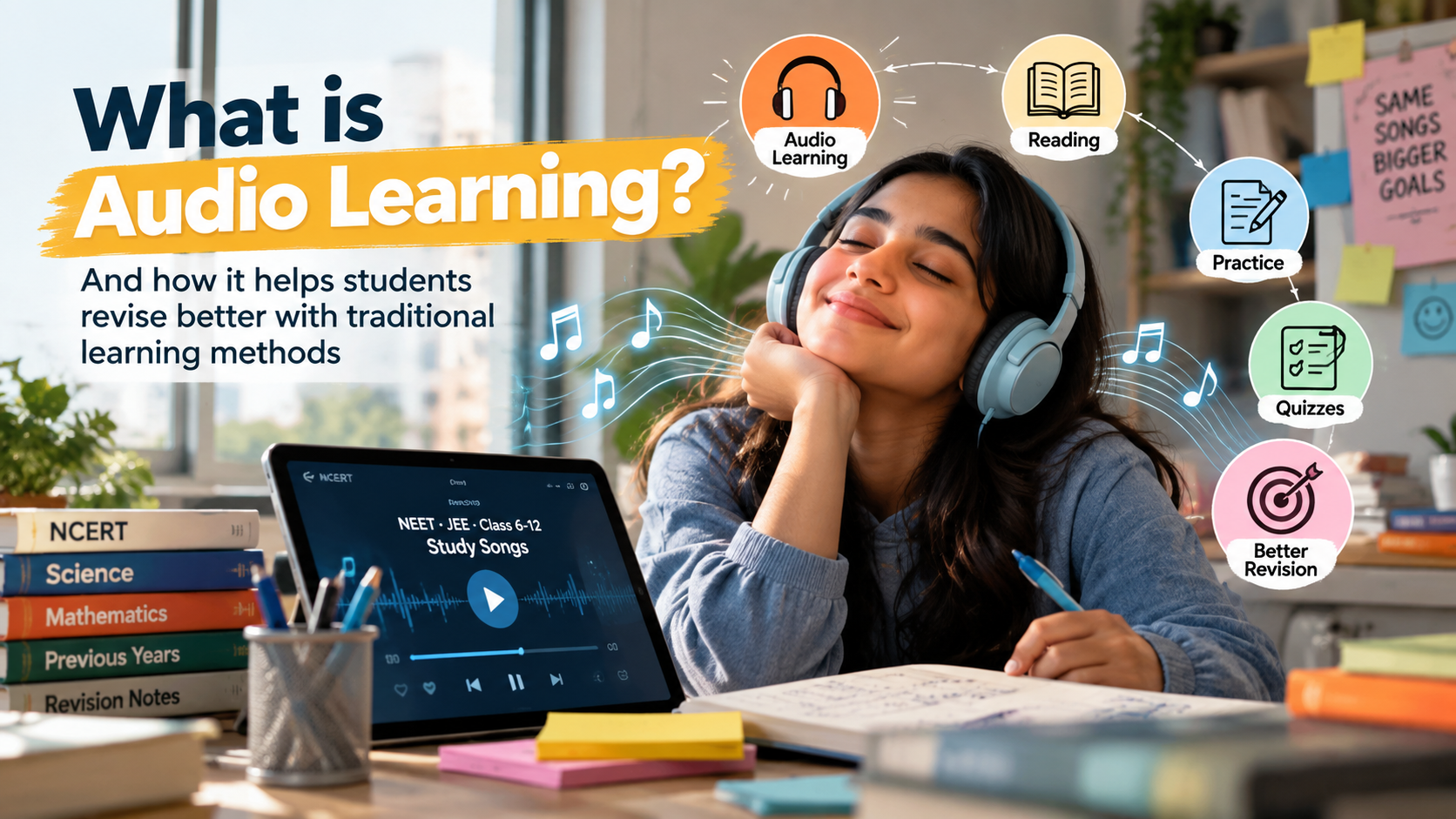
Audio learning is a way of using spoken explanations, educational recordings, study songs, or other audio content to support learning and revision. For students, it can provide another way to revisit information without always relying on written material or continuous screen use. Audio learning works best as part of a wider study routine that also includes reading, practice, recall, quizzes, and guidance from teachers.
What Is Audio Learning?
Audio learning means learning or revising through content that is primarily delivered through sound. Instead of reading every piece of information from a textbook, website, or screen, students can listen to explanations, summaries, lessons, study songs, or other educational recordings.
The format can be as simple as listening to an explanation of a familiar topic or as structured as following an audio lesson created around a curriculum or subject.
Audio learning is not one single teaching method. Its usefulness depends on the type of content, how it is designed, what the student is trying to learn, and how it is combined with other learning activities.
How Does Audio Learning Work for Students?
Audio learning delivers information through listening. A student may hear an explanation, definition, sequence, example, question, or study song and then use that information to understand or revisit a topic.
For revision, audio can be particularly useful when the student has already encountered the topic through regular study. Listening can provide another opportunity to revisit familiar information and recall important points.
A simple audio-based revision cycle could look like this:
Learn the topic through normal study.
Listen to a relevant audio explanation or revision resource.
Try to recall the important points.
Return to notes or a textbook to check gaps.
Use questions or quizzes to test understanding.
Why Are Students Interested in Audio Learning?
Students have different learning schedules and study environments. There are situations where reading from a book or screen may not be convenient, while listening is possible.
For example, students may have opportunities to listen while travelling as passengers, during suitable breaks, or when they want an alternative to continuous visual study.
Research on mobile learning has also examined how audio and podcast-based resources can provide learners with greater flexibility in when and where they access educational content. However, the effectiveness of any audio resource depends on factors such as the learner, content, context, and purpose.
What Are the Different Types of Audio Learning?
Audio learning can take several forms depending on the subject and the student's needs.
1. Audio Lessons
Audio lessons can explain a topic in a structured sequence, similar to a short spoken lesson. They may be useful when students want to revisit a concept they have already encountered.
2. Study Songs
Study songs combine academic information with rhythm, repetition, and lyrics. This format can provide another way to revisit selected curriculum-based information.
3. Audio Summaries
Short summaries can help students quickly revisit key points from a topic without going through the complete chapter again.
4. Question-Based Audio
Some audio resources can present questions or prompts that encourage students to think about an answer before continuing.
5. Revision Recordings
Students or teachers can also create recordings that focus on important definitions, explanations, formulas, or concepts that need repeated revision.
Can Audio Learning Help Students Revise?
Audio can be useful for revision when it is used to revisit information that students have already studied. Repeated exposure to important concepts through another format can make it easier to fit revision into different parts of a student's routine.
However, listening alone does not show whether a student can independently recall or apply the information. For that reason, audio revision should be combined with active recall, question practice, written work, and self-assessment.
A student might listen to a revision track and then later answer questions about the same topic. This creates an opportunity to check whether the information can actually be retrieved and applied.
Can Audio Learning Reduce Continuous Screen Use?
Audio provides a learning format that does not require the student to continuously look at a screen. This can be useful when students want to include some non-visual revision in their routine.
It does not mean that screens should be completely removed from learning. Digital resources, online classes, educational videos, practice platforms, and other tools can all have a role in education.
The practical benefit of audio is that it gives students another option when continuous visual attention is not necessary for the task.
Can Students Use Audio Learning While Travelling?
Yes, audio learning can be particularly convenient for suitable travel situations. Students travelling as passengers can listen to previously studied concepts, summaries, educational audio, or study songs.
This can turn some otherwise unused time into an opportunity for light revision without requiring a textbook or continuous screen viewing.
Students should still treat travel listening as supplementary revision. New and difficult concepts may require a focused environment where students can read, write, solve problems, and ask questions.
For more practical ideas, students can explore the NEET BAND Courses and see how audio-based resources can fit into a broader learning routine.
Is Audio Learning Suitable for School Students?
Audio learning can be used by school students when the content is appropriate for their age, curriculum, and learning needs.
Younger students may benefit from short, simple, and engaging audio content, while older students may use audio for concept explanations, revision summaries, study songs, or exam-oriented revision.
The format should always match the learning objective. A student learning a mathematical procedure, for example, may need written examples and problem-solving alongside any audio explanation.
Can Audio Learning Help NEET and JEE Students?
NEET and JEE preparation involves substantial concept learning and question practice. Audio can be used as an additional format for revisiting familiar concepts, definitions, explanations, and other revision material.
It should not replace the activities that require active problem-solving. Students still need to work through questions, practise calculations, analyse mistakes, revise concepts, and test their understanding.
A practical approach could be to use focused study sessions for learning and problem-solving, while using suitable audio resources during appropriate parts of the day for additional revision.
What Are the Benefits of Audio Learning for Students?
The usefulness of audio learning varies between students, but the format can offer several practical advantages.
Flexibility: Students can access suitable content in more situations.
Another revision format: Information can be revisited through listening rather than reading alone.
Less continuous visual dependence: Listening does not always require looking at a screen.
Convenient repetition: Familiar content can be revisited when appropriate.
Short revision opportunities: Small gaps in the day can sometimes be used for light revision.
These benefits do not mean audio is automatically better than reading or classroom learning. It is simply another format that can be useful in the right context.
What Are the Limitations of Audio Learning?
Audio is not suitable for every type of learning task.
Subjects and concepts that require diagrams, detailed calculations, graphs, written equations, visual demonstrations, or extensive problem-solving may require other forms of study.
Students also need opportunities to actively retrieve and apply information. Listening to an explanation can create familiarity, but students should still test themselves to find out what they can actually remember.
For this reason, audio works best when it is integrated into a broader learning system rather than used as the only study method.
How Can Students Combine Audio Learning with Traditional Study?
A balanced study routine can use different formats for different purposes.
Learning Activity Possible Role Textbook or notes Detailed learning and reference Teacher or classroom Explanation, guidance, and clarification Audio learning Flexible listening and supplementary revision Questions and quizzes Testing recall and understanding Written practice Application and problem-solving
Using the right format for the right task can make a study routine more flexible without removing the traditional methods that students depend on.
How Does NEET BAND Use Audio Learning?
NEET BAND is built around curriculum-aligned study songs and audio learning, alongside other resources such as notes, Q&A content, and quizzes.
Its approach is designed to give students another way to revisit academic content, particularly when they want a flexible alternative to continuous reading.
Students can explore the NEET BAND Courses to see the available learning resources.
More information about the platform and its approach is available on the NEET BAND About page.
How Can Parents Introduce Audio Learning to Children?
Parents do not need to make audio learning another compulsory task. It can be introduced as an optional addition to an existing study routine.
Parents can help children decide when audio is appropriate and ask them to explain what they remember after listening. This keeps the focus on learning rather than simply spending more time with educational content.
For younger children, parents can also listen together and discuss the topic afterwards. This can help connect audio content with conversation and active recall.
How Can Students Make Audio Learning More Effective?
Listening becomes more useful when students actively connect it with what they already know.
Try this simple process:
Choose a topic you have already studied.
Listen to a relevant audio resource.
Pause and recall the main points.
Identify anything you could not remember.
Check your notes later.
Test yourself with questions or a quiz.
This turns audio from passive listening into one part of a more active revision process.
Frequently Asked Questions
What is audio learning in education?
Audio learning is the use of spoken educational content, recordings, study songs, audio lessons, or similar resources to support learning and revision.
Is audio learning better than reading?
Audio and reading serve different purposes. Reading can be important for detailed information, diagrams, written examples, and reference material, while audio can provide another flexible way to revisit information. Neither format needs to replace the other.
Can audio learning help with revision?
Yes. Audio can be used as a supplementary revision format, particularly for revisiting concepts that have already been studied. Students should combine listening with recall, questions, and other forms of practice.
Can children learn through audio?
Children can use age-appropriate educational audio, provided the content matches their learning needs. Audio can complement reading, classroom teaching, written activities, and other learning experiences.
Can audio learning be used for NEET and JEE?
Audio can support revision of familiar concepts for NEET and JEE students, but it should not replace detailed study, problem-solving, question practice, or self-assessment.
Quick Takeaway
Audio learning gives students another way to access and revisit educational content through listening. It can make revision more flexible, provide an alternative to continuous visual study, and fit into suitable parts of a student's day.
The most useful approach is to combine audio with traditional learning methods. Learn concepts properly, practise questions, use active recall, and then use audio when it adds value to your revision routine.
Want to Explore NEET BAND?
Have questions about NEET BAND courses, study songs, or audio learning for students?
Follow NEET BAND on Instagram for study-related content and updates.
Comments (0)
Please log in to join the discussion.
No comments yet. Be the first to share your thoughts!